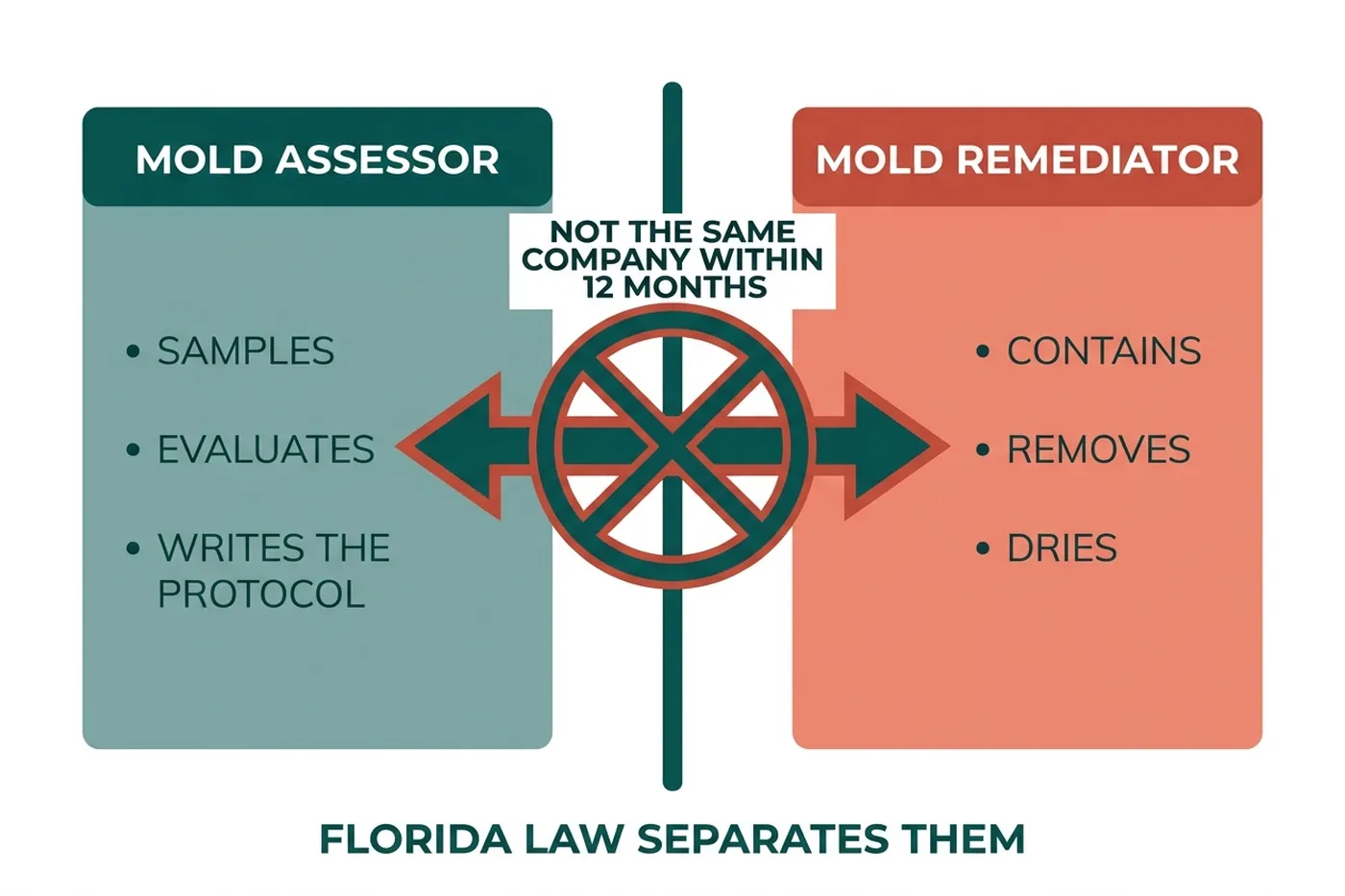
Mold removal in Tallahassee costs $1,500–$6,000 for most remediation and $6,000–$15,000 whole-home. A licensed assessment is a separate $300–$800 from a different company, because Florida bars one firm from doing both within 12 months.
Which invoices you may face, what each buys, and when you only need one of them.
Two possible invoices, from two companies
| Who | What they produce | Cost |
|---|---|---|
| Licensed mold assessor | Sampling, findings, a written protocol you can give to anyone | $300–$800 |
| Mold remediator (Florida-licensed; ask for the number) | Containment, removal, cleaning, drying to a measured target | $1,500–$15,000 |
| Remediation walkthrough and quote | A look and a written price: no sampling, no findings | Often free; ask |
The third row is not a discounted version of the first. It answers a different question, and conflating them is how homeowners end up believing they have been assessed when they have not.
What the removal itself costs
| Work | Typical range | What drives it |
|---|---|---|
| Mold remediation | $1,500–$6,000 | How much porous material has to leave the building |
| Whole-home remediation | $6,000–$15,000 | Multiple rooms plus contents handling |
| Crawl space | $2,500–$9,000 | Clearance, framing affected, whether a barrier goes in |
| Attic | $1,500–$5,000 | Access and the volume of contaminated insulation |
| Storm and tree damage | $1,000–$8,000 | How long the opening stayed open |
| Water damage | $1,000–$8,000 | Water category far more than volume |
When you only need a remediator
Visible growth, an obvious water source, nobody disputing anything, and no claim involved. In that situation an assessment mostly confirms what is already in front of you, and going straight to remediation is the sensible use of your money.
Add any of the following and the assessment stops being optional: a smell with nothing visible, a sale or purchase, an insurance claim, a landlord or tenant dispute, or a situation where you want somebody with no share of the removal invoice to say what is happening. The reasoning is on the inspection page.
Why the cheap quote is cheap
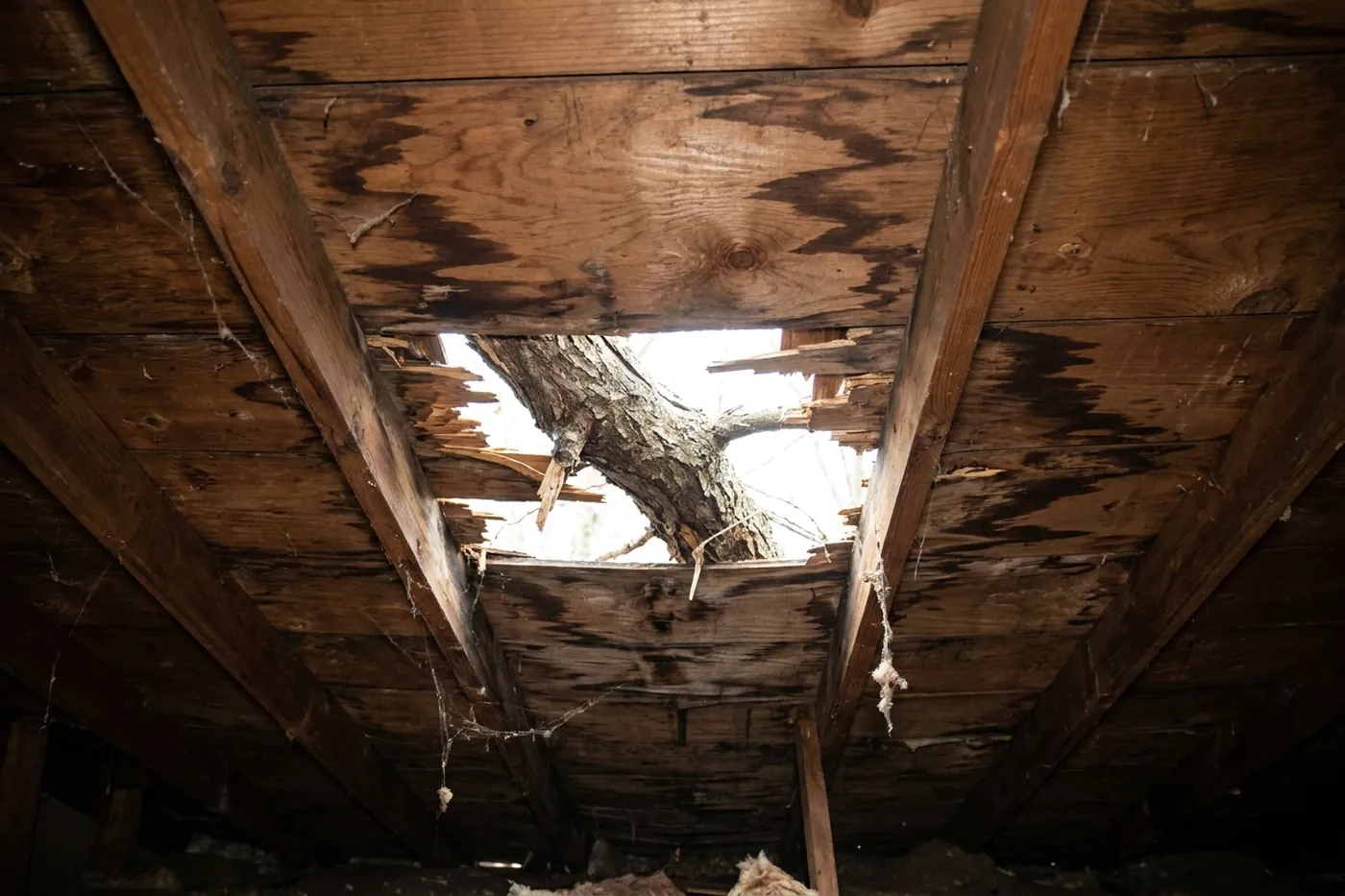
Almost always because it is a cleaning. Removing what you can see is easy. Finding and correcting the water that produced it is the skilled part, and under this canopy the source is frequently a roof plane that never dries or storm damage nobody traced fully.
The test is a single sentence: does the scope name where the water came from? Not "moisture intrusion", the actual path. A quote without that sentence is priced to be cheap and scoped to come back.
Insurance, briefly
Storm and tree damage has the best prospects on this list, because wind is a named peril and the water follows from it. Humidity, condensation and slow leaks are treated as building conditions rather than events and are generally excluded, and many policies carry a mold sublimit set well below the dwelling limit. Find that cap before deciding whether a claim is worth making.
Cost questions, in plain terms
What is the average mold removal cost in Tallahassee?
Most remediation runs $1,500-$6,000, whole-home $6,000-$15,000. Crawl space work is $2,500-$9,000, attic $1,500-$5,000, storm and water damage $1,000-$8,000. A licensed assessment, if you need one, is a separate $300-$800 paid to a different company.
Why is the assessment billed separately?
Because it is a separate business. Fla. Stat. 468.8419 bars a remediator from assessing a structure it remediates within 12 months and vice versa, so those two invoices come from two companies by design. Anyone bundling them should be asked which basis they are operating on.
Do I always need both?
You don't always need both. Where growth is visible, the cause is obvious and nobody is disputing anything, you can go straight to a remediator. The assessment earns its fee when the source is hidden, when a transaction or claim is involved, or where independence is the thing you are buying.
What makes one remediation quote cheaper than another?
Usually that it is a cleaning rather than a remediation. Removing visible growth is straightforward; identifying and correcting the water that produced it is the part that takes expertise, and it is the part a cheap quote tends to omit. Check whether the scope names the source.
Is any of it covered by insurance?
Storm and tree damage stand the best chance, because wind is a named peril and the water entry follows from it. Humidity, slow leaks and condensation are treated as conditions rather than events and are generally excluded. Many policies also carry a mold sublimit well below the dwelling limit.
What does the 10 square foot threshold change?
Both statutory definitions apply above 10 square feet of growth. Below it neither licence category is engaged, which means a genuinely small patch is not a regulated process. It also means the visible surface area is not necessarily the measurement that counts once a cavity is opened.
How many quotes should I get?
Two that name the moisture source beat four that give a total. A useful remediation quote states where the water came from, what is being removed versus dried, a drying target as a number, and what happens if the scope grows once materials are opened.
Get a Tallahassee remediation quote
If you already hold an assessor’s protocol, say so, and the remediator can quote directly against it. If you do not, describe what you have found and roughly how large an area it covers. Ten square feet is the line Florida draws, and knowing which side of it you are on changes what you need next. You get a call back from a local specialist who serves Tallahassee.