Florida has no mold-specific rental statute. Fla. Stat. 83.51 requires landlords to meet applicable building, housing and health codes, or keep roofs, walls, floors, foundations and plumbing in good repair. Crucially, those duties may be modified in writing for a single-family home or duplex.
What the law actually says, the clause that changes it in a rental house, and what to do in the first hour.
The duty is general: there is no mold removal statute
People search for "Florida mold law for renters" expecting a statute about mold. There is not one for residential tenancies. What exists is a general maintenance obligation in Fla. Stat. 83.51: comply with applicable building, housing and health codes, or where none apply, maintain the roofs, windows, doors, floors, steps, porches, exterior walls, foundations and other structural components in good repair, and the plumbing in reasonable working condition.
Mold claims attach to those duties indirectly. A roof that leaks or plumbing that does not work engages the statute; mold is the consequence you are pointing at as evidence.
The clause that matters in a rental house
Read this one carefully, because it is the difference between an apartment and most student housing here. The statute provides that the landlord’s obligations under that subsection may be altered or modified in writing with respect to a single-family home or duplex.
Tallahassee’s rental market contains an unusually large number of single-family houses and duplexes let to students. If that is your situation, what your lease says about maintenance responsibility is not boilerplate. It may have shifted duties the statute would otherwise place on the landlord. Find your lease before you find an argument.
What to do in the first hour
- Photograph it, dated, wide and close, including the surrounding room.
- Report it in writing. Text or email, describing what and where. A verbal report to a leasing office is the thing tenants most often cannot later prove.
- Keep your copy. Not just the sending: the record.
- Note any water source you can see, and when it started.
- Do not clean it away before it is documented, however tempting.
Where a mold removal company fits, and where it does not
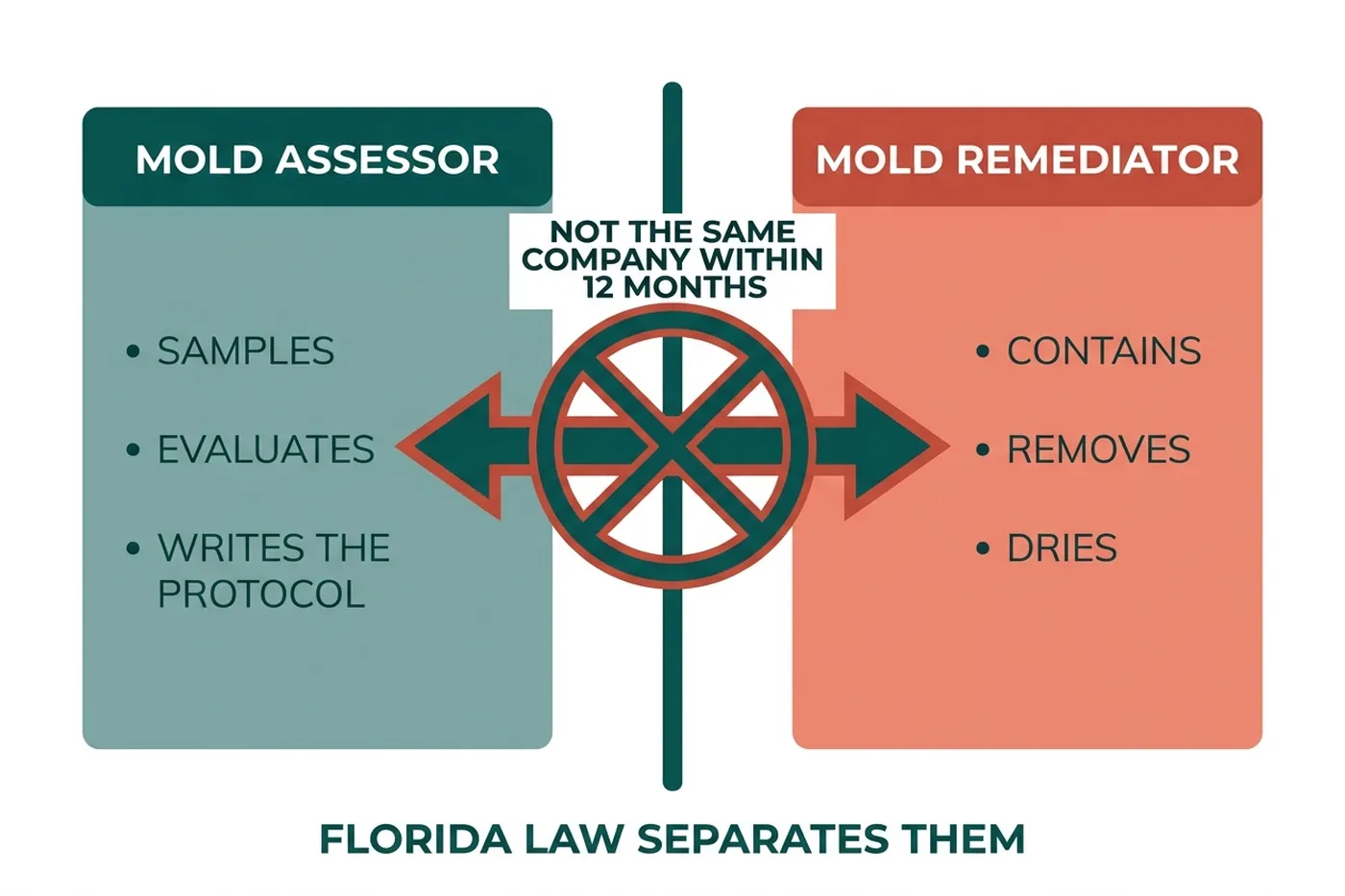
| You need | Who provides it |
|---|---|
| A document that holds up in a dispute | An independent licensed mold assessor |
| Advice about withholding rent or terminating | A tenant advice service or a lawyer |
| The mold physically removed | A remediator, usually engaged by the landlord |
| To know whether it is over 10 square feet | A quick question for the remediator |
We pass requests to a remediator. We are not a law firm and nothing here is legal advice: Florida has a specific statutory procedure for tenant remedies with notice requirements, and getting that wrong can leave you worse off than doing nothing.
Renting, in plain terms
Does Florida have a mold law for rental housing?
Not a mold-specific one. Fla. Stat. 83.51 requires a landlord to comply with applicable building, housing and health codes, or where none apply, to keep roofs, windows, doors, floors, exterior walls, foundations and other structural components in good repair and the plumbing in reasonable working condition. Mold claims attach to those duties.
Can my landlord contract out of that?
For a single-family home or duplex, partly. The statute says the landlord's obligations under that subsection may be altered or modified in writing with respect to a single-family home or duplex. In a large share of Tallahassee student housing that is exactly the property type, so the lease matters.
What should I do first if I find mold in a rental?
Report it in writing and keep a copy - text or email, dated, describing what and where. Photograph it. Verbal reports to a leasing office are the single most common thing tenants cannot later prove, and the written record costs nothing to create.
Who pays for the assessment?
There is no automatic answer, and it depends on the lease and who is disputing what. If you need a document that will hold up, an independent licensed assessor is what produces it. A remediator's quote is not a finding, and it will not carry the same weight.
Can I withhold rent?
Florida has a specific statutory procedure for tenant remedies with notice requirements, and getting it wrong can put you in a worse position than doing nothing. This is the point to talk to a tenant advice service or a lawyer rather than to a mold company. A remediator removes mold; this site does not give legal advice.
Get a Tallahassee remediation quote
If you already hold an assessor’s protocol, say so, and the remediator can quote directly against it. If you do not, describe what you have found and roughly how large an area it covers. Ten square feet is the line Florida draws, and knowing which side of it you are on changes what you need next. You get a call back from a local specialist who serves Tallahassee.