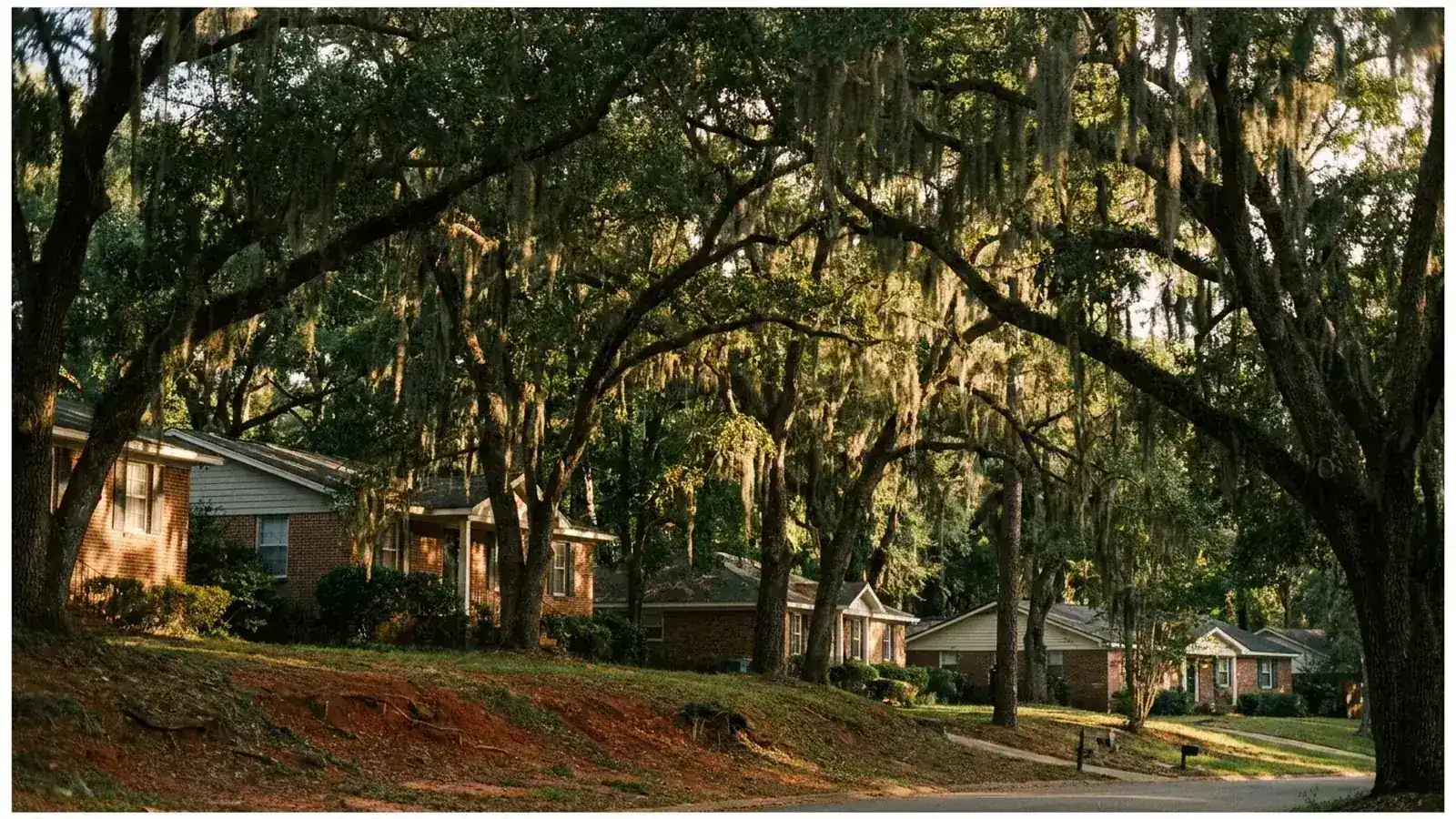
HVAC and AC mold removal in Tallahassee runs $1,500–$6,000 for most work. The dense live oak canopy that shades this city keeps roof planes and attics damp, and ductwork in a shaded attic behaves quite differently from ductwork in one that dries out.
Why the equipment is under unusual load here, where growth appears first, and what actually stops it.
Shade is a moisture mechanism
Tallahassee sits in the Red Hills on rolling terrain under an unusually dense live oak canopy, and that shade is not merely pleasant. It is a moisture mechanism in its own right. Roof planes and north elevations stay damp far longer than they would in the open, and an attic beneath them does not get the solar drying that a sunlit attic relies on.
Most air conditioning ductwork in this housing stock runs through that attic. A duct that leaks in a space which never fully dries pulls damp air into the system continuously, and the coil and plenum are where it shows. The attic page covers the deck; this one covers what the equipment does with it.
Who may tell you what it is
Florida separates mould diagnosis from mould cure by statute. Under Fla. Stat. 468.8419 an assessor may not remediate a structure their company assessed within twelve months, and Fla. Stat. 468.8411 defines assessment as including physical sampling and evaluation of building history to form a hypothesis about origin.
Your request goes to one independent local remediator, who quotes and performs removal and does not sell the assessment that would justify their own invoice. Where you need sampling to know what is in the ductwork, that is a licensed assessor's work, and this page explains the split.
What does it smell like when it is the AC?
The tell is timing. Why does the smell arrive a few seconds after the system kicks on and fade when it stops? Because the source is inside the equipment or the duct rather than in the room. People describe it as damp towels, a cellar, or occasionally something sharper.
These are the signs you are looking at an equipment problem rather than a room one: allergies worse indoors with the air running than outdoors, dark specks appearing at the supply registers, staining on the ceiling around a vent, water standing around the air handler, and a system that has started short-cycling. Notice two of those together and the equipment is usually the source.
What causes it is almost always one of four things: a blocked condensate drain, a leaking return pulling unconditioned air in, equipment oversized for the house, or humidity the system was never sized to remove. Standing water around the air handler is the one to treat as an emergency rather than a seasonal nuisance. A blocked drain keeps filling, and the damage spreads into the platform and the floor beneath it.
What the work involves
- Document: photographs and moisture readings at the air handler, the coil, the drain pan and along the accessible duct run
- Establish the source: a blocked condensate drain, a leaking return, an oversized system, or humidity the equipment was never sized to remove
- Clear: contaminated insulation and lining out where it is holding moisture
- Treat: antimicrobial application across affected surfaces
- Refer what is not remediation: duct sealing, coil replacement and equipment sizing are an HVAC contractor's work, in writing
The remediator cleans and remediates. They do not size, service or certify air conditioning equipment, and a good one will not quote a clean they can see will not hold while the underlying fault is still there.
Asked about AC mold
Does the remediator clean the ductwork itself?
The remediator cleans contaminated surfaces and removes lining and insulation that is holding moisture. Duct sealing, coil replacement and equipment sizing are an HVAC contractor's work, and a good remediator refers them in writing rather than quoting around them.
Why does it keep coming back after a clean?
Almost always because the moisture source is still there: a blocked condensate drain, a leaking return, or equipment that satisfies the thermostat before it has removed enough moisture. Cleaning without correcting it is a repeat purchase.
What does it cost?
$1,500–$6,000 for most work, driven by how much of the system and surrounding material is affected. Whole-home remediation runs $6,000–$15,000.
How do I know if it is the AC or the room?
Timing. If the smell tracks the system switching on and off, the source is in the equipment or the duct. If it is constant regardless, look at the room and the building envelope first.
What is the system telling you?
Under the canopy, Tallahassee systems fight shade-cooled surfaces and nearly 60 inches of rain; ducts through a damp, shaded attic run cold against air that never quite dries.
| Situation | What it means | The local pattern |
|---|---|---|
| Smell arrives on start-up | The source rides the airflow: equipment or duct | Start-up smell under this canopy usually traces to coil or plenum, both stay damp |
| Smell constant, system off | The room, not the machine. Find the moisture source | Constant smell means the building, and canopy shade gives it plenty of candidates |
| Dark specks at supply registers | Growth downstream of the coil, usually duct or boot | Register specks report duct growth: common where runs cross shaded roof planes |
| Water standing at the handler | A blocked condensate line: urgent, not seasonal | Handler water needs the same-week response here; nothing evaporates under the oaks |
One boundary the statute sets: if you want sampling to name what is growing, that is an assessor's work and Florida bars the remediator from selling it alongside removal. The cleanup itself is the remediator's.
Get a Tallahassee remediation quote
If you already hold an assessor’s protocol, say so, and the remediator can quote directly against it. If you do not, describe what you have found and roughly how large an area it covers. Ten square feet is the line Florida draws, and knowing which side of it you are on changes what you need next. You get a call back from a local specialist who serves Tallahassee.