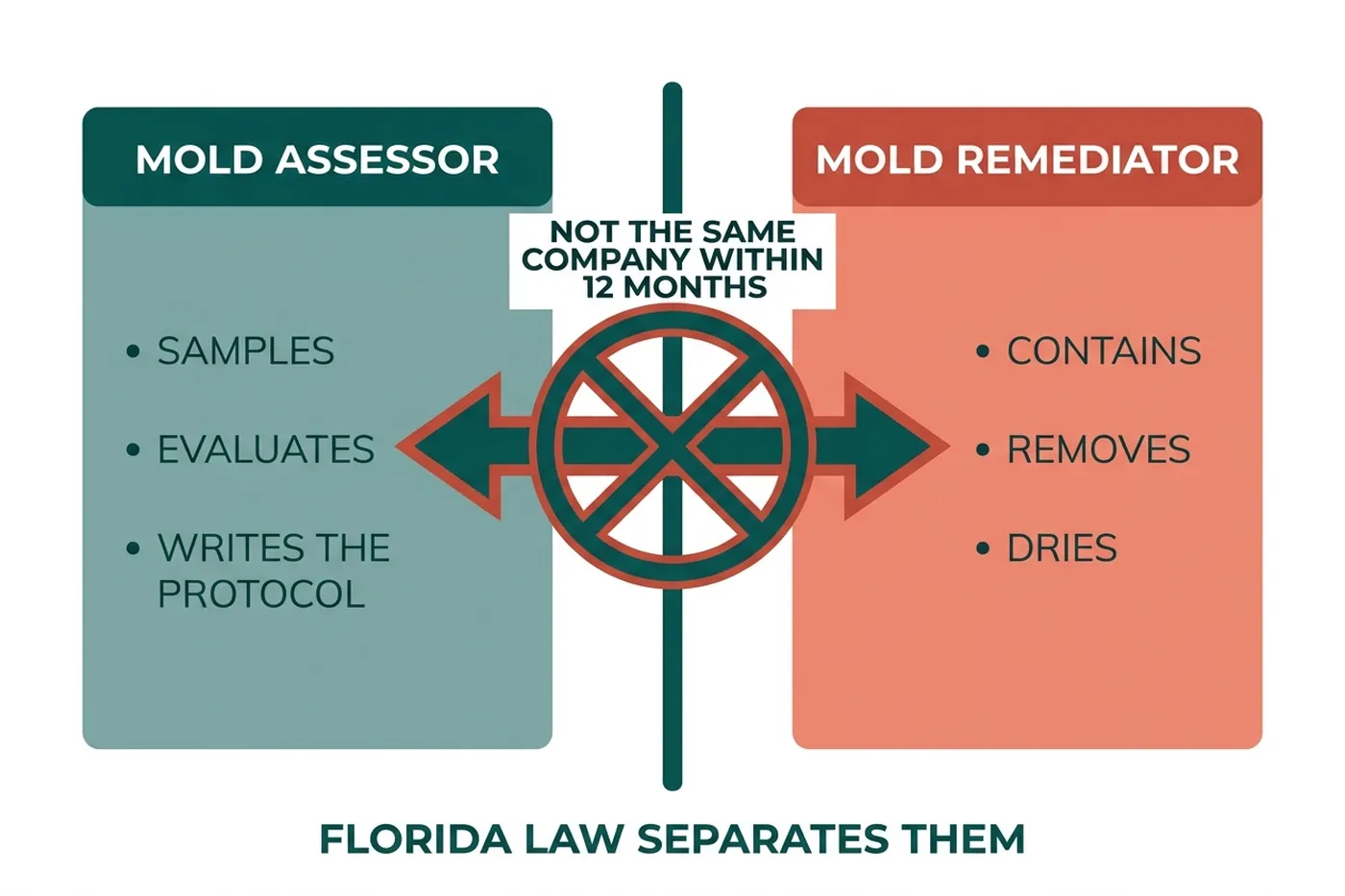
Florida licenses mold assessors and mold remediators separately, and Fla. Stat. 468.8419 bars each from doing the other’s work on the same structure within 12 months. Referral payments between them are prohibited in both directions. Your request goes to one independent local remediator, who must hold a Florida licence: ask for the number.
What each licence covers, what the statute forbids, the 10-square-foot threshold, and the exception worth asking about.
Two roles, defined by statute
Mold assessment (468.8411) is a process that includes physical sampling together with evaluation of building history and inspection, to form a hypothesis about the origin, identity, location and extent of mold growth greater than 10 square feet. The sampling is the part that makes it an assessment rather than a look.
Mold remediation is the removal, cleaning, sanitising, demolition or other treatment, including preventive activities, of mold greater than 10 square feet.
Notice that both definitions carry the same threshold. Below 10 square feet, neither licence category is engaged at all.
What the statute forbids
| Prohibition | Applies to |
|---|---|
| Remediating a structure your company assessed in the last 12 months | Assessors |
| Assessing a structure your company remediated in the last 12 months | Remediators |
| Inspecting or remediating for a fee a property you hold a financial interest in | Both |
| Accepting compensation or reward from the other side for referrals | Both |
| Offering compensation or reward to the other side for referrals | Both |
| Taking an assessment engagement where the fee depends on the findings | Assessors |
The last row is the quiet one and arguably the most important. An assessment that pays more when it finds more is not an assessment, and Florida said so explicitly.
The exception, and why to ask about it
The 12-month bar does not apply to a certified contractor classified as a Division I contractor under s. 489.105(3). The department may require that where such a contractor performs one and offers the other, the contract discloses the homeowner’s right to request competitive bids.
So a company offering to do both is not automatically operating improperly. It may hold that classification. It is a perfectly fair question to ask which basis they are working on, and a straight answer is easy to give if the answer is good.
What this means when you are buying
In practice you are dealing with a two-company market, and the sequence that works is: assessor first where sampling or documentation is needed, then remediator quoting against their protocol, then, where the stakes justify it, the assessor verifying afterward. That verification means something precisely because the verifier has no share of the removal invoice.
Where you simply have visible growth and an obvious cause, you may not need an assessor at all. See how a quote gets built without sampling on the remediation page, or what an assessment should cost on the inspection page.
The split, in plain terms
Can one company do both mold testing and mold removal in Florida?
Not on the same structure within 12 months, in either direction. Fla. Stat. 468.8419 bars an assessor from remediating a structure their company assessed in the previous year, and bars a remediator from assessing a structure their company remediated in the previous year. A Division I certified contractor exception exists.
Why did Florida separate them?
Because a company that both diagnoses and cures has a financial reason to find more disease. The statute also blocks the softer version of that: neither side may accept or offer compensation, inducement or reward to the other for referrals, and an assessor may not take a job where the fee depends on what the assessment concludes.
What counts as a mold assessment?
Fla. Stat. 468.8411 defines it as a process including physical sampling plus evaluation of building history and inspection, to form a hypothesis about the origin, identity, location and extent of mold growth greater than 10 square feet. The sampling is what distinguishes it from simply looking.
Does this apply to small patches?
Both statutory definitions are written around growth greater than 10 square feet. Below that threshold the licence categories are not engaged. A visible patch smaller than a sheet of plywood is not automatically a regulated process, whatever anyone tells you.
What is the Division I contractor exception?
The 12-month bar does not apply to a certified contractor classified as a Division I contractor under s. 489.105(3). The department may require that where such a contractor does both, the contract discloses the homeowner's right to request competitive bids. Ask which basis a company is operating on.
What are the penalties?
The statute carries escalating criminal penalties for violations. That is unusual for a licensing provision and tells you how seriously the separation is meant to be taken - it is not a professional courtesy, it is the structure of the market.
Get a Tallahassee remediation quote
If you already hold an assessor’s protocol, say so, and the remediator can quote directly against it. If you do not, describe what you have found and roughly how large an area it covers. Ten square feet is the line Florida draws, and knowing which side of it you are on changes what you need next. You get a call back from a local specialist who serves Tallahassee.